
The Ladder tool
An activity to help you break your goals down into manageable, bite-sized chunks

Written by Cheyenne
It's normal to experience times where we may have thoughts such as 'I just can’t see how to progress', 'I feel like I've ruined everything', 'I've completely lost all routine'.
Life is busy and often our focus can get moved away from our health and wellbeing to an area that's more important at that time, whether that be a busy period at work, childcare, or an unwell relative. It's also easy to de-prioritise our health and put it on the back burner, as we often don't see any negative impacts of doing this in the short term. However, if we keep de-prioritising our health over and over again, we can end up putting our physical and mental wellbeing at risk.
In order to help you recognise how far you've come (even when when you might be feeling demotivated), and to help you remember what worked well for you in the past, you can use our 'Ladder' activity. This can help you refocus on your goals and give you a boost of motivation to get going.
The Ladder
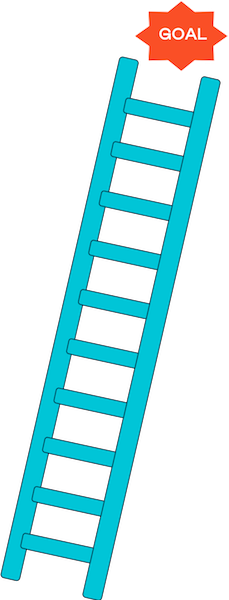
The ladder is a step by step approach that helps to break down your goals into more realistic, bite-sized chunks. At the same time, it allows you to acknowledge what needs to be implemented at each stage to move towards your ultimate goal.
Take the time to write down your responses to each stage of this exercise and notice how you feel when working through the questions.
Stage 1
Start by thinking about what your end goal is, which is represented by the top step of a 10-step ladder.
What is the environment you can envision surrounding you at your end goal?
How will you look?
How will you feel?
Is anyone else with you when you picture yourself at your end goal?
How are others responding to you when you reach this target?
What will you gain reaching this goal?
What will you lose reaching this goal?
At this stage, it's important to consider whether the goals you've set invoke a positive emotion or reaction. If they don’t, we'll naturally move away from any outcomes that ultimately make us feel negative as a protective mechanism. This can then be misconstrued as sabotage or failure.
Stage 2
Next, move back to the bottom step of the ladder and repeat the same set of questions, but this time, think about where you were at the start of your wellbeing journey.
What was the environment you picture yourself in at the start of your journey?
How did you look?
How did you feel?
Was anyone else with you when you picture yourself at the beginning of your journey?
How were others responding to you then?
What will you gain staying here?
What will you lose staying here?
Stage 3
Now acknowledge which step of the ladder you're on at this moment in time. From here, can you start to consider what internal and external resources you've used to get to this point. For example, this might be family support, the 'Couch to 5km' app, meal prep, or tracking your steps.
Example: 'I'm now on step 4. To get here, I've told friends and family about my journey so they can support me, I've done a weekly meal plan and shop to stay organised, I've committed to walking with a friend 3 times a week, and I've aimed to meet my steps goal every day.'
Stage 4
Finally, think about what it looks like for you to move up to the next step. What do you feel you need to implement to do this?
Remember, being consistent and continuing with what you're already doing is a goal in itself. We don't always need to be adding 'new goals' to progress.
Example: 'To reach the next step on the ladder, I'm going to continue doing a weekly meal plan and shop and aim to meet my daily steps goal. I'm also going to start focusing on having 8 glasses of water each day and going to bed at the same time every night. I know when I've done this in the past, it's had a really positive impact on how I feel.'