
Reading food labels

Written by Cheyenne
In this guide, we’ll walk you through some of the simplest ways to feel confident making healthy choices when looking at food labels (spoiler: we won’t ask you to look at the calories!).
The ingredients list
It’s required by law for all pre-packaged foods to include an ingredients list on the food label. This is probably the best thing to help us know whether this is a food we want to buy.
Ingredients are listed in order of weight, this means the main ingredients in the product will always come first. Any allergens will be shown in bold.
When looking at an ingredients list, it might be helpful to consider the following two questions:
1. How long is the ingredients list?
Generally, a longer list of ingredients suggests a more processed food. Having a long list of ingredients doesn’t necessarily mean the food is ultra-processed or should be avoided, it’s just a tool we can use to better understand what’s going into our food.
If a food has a long list and it’s something that accounts for a big part of our diet, then it would be a good idea to find a whole food alternative. But if it’s something we use in small amounts or less often, then it’s ok.
2. What are the main ingredients (i.e. the first ingredients in the list)?
Ideally, we want the main ingredients to be foods that we recognise as whole foods. Ultra-processed food products will often include names of things that we don't recognise as foods.
If there’s sugar in the ingredients list then we know sugar has been added to the food, rather than naturally occurring.
Naturally occurring sugar is the sugar that’s already part of the whole food - for example, in a piece of fruit. We wouldn’t see this sugar listed as an ingredient.
Added sugar is the sugar that manufacturers add to food during processing, for example adding sugar to a biscuit recipe. This type of sugar will be on the ingredients list.
If the sugar comes in the first few ingredients, we know the food is high in added sugar. Foods with added sugar can be ok to have occasionally, but we recommend trying to reduce these. If a food you're having frequently contains added sugar, you might like to try and swap to an alternative. We have some swap suggestions below!
Added sugar may also be listed under less obvious names such as agave nectar, apple juice concentrate, barley malt syrup, cane juice, crystallised fructose, dextrose, fructose, fruit juice concentrate, maltose, molasses, sucrose, and treacle. So keep an eye out for those too.
Here’s an example of an ingredients list for a vegetable soup:
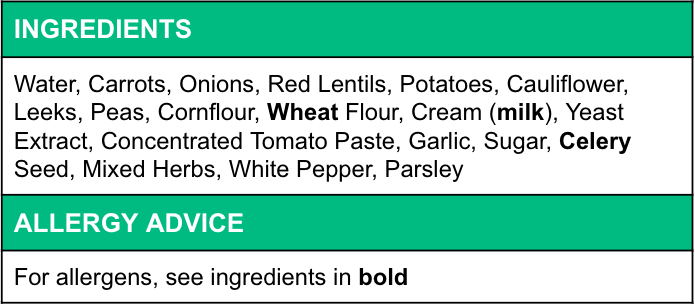
There are a couple of things we can notice from this list:
Although the list is quite long, most of the ingredients are recognisable as whole foods so this wouldn’t be an ultra-processed food
There’s sugar in the ingredients list which means sugar has been added to the product, rather than being there naturally. If you can find a soup without any added sugar and with whole ingredients, that would be the best choice. If you can't do this, then opt for a soup where the added sugar is towards the end of the ingredients list (like this one), which means it's likely to only be a small amount.
Remember, these tools are there to help you, not to hinder you. If you’re feeling confused or overwhelmed by the ingredients list, think about the overall product - is this something that will help you work towards a balanced diet?
The balanced plate model
If you’re choosing a meal at a restaurant, cafe, or shop, it can be helpful to remind yourself of the balanced plate model and try to base the meal you choose on this.
Consider the following:
Aim to pick a dish that contains a good source of protein (e.g. chicken, meat, pulses, or fish) and some vegetables. Meals that are based on refined carbohydrates (such as white rice, bread, or pasta) are unlikely to keep you feeling full and satisfied for very long.
Seek out meals that contain whole food ingredients. For example, if you’re choosing between a pastry sausage roll or a wholegrain cheese and vegetable wrap, the wrap is likely to be the healthier choice. This is because it’s made of whole foods and provides a source of protein, fat, complex carbohydrates, and vegetables. The pastry is likely to be processed, higher in refined carbohydrates, and doesn't fit as well into the balanced plate model.
Restaurants and pre-prepared meals often contain bigger servings of carbohydrates than we need, so be mindful of this and consider teaming up with a friend to share your complex carbohydrate portions (e.g. chips, potato wedges, or rice) or save some for later
Consider getting a side of vegetables or salad to accompany your main meal and help to balance your plate
If you’re in a restaurant, don’t be afraid to ask how your meal will be cooked - dishes that are crispy, fried, creamed, sautéed, pan-fried, or crunchy tend to be less nutritious than foods that are steamed, grilled, baked, or poached. For example, if there’s fish and chips on the menu then it’s likely the fish will be deep-fat fried, so it might be better to choose steamed salmon instead.