
How to calculate carbohydrate servings
Instructions on how to calculate your carbohydrate serving sizes from food labels and recipes, plus other ways to measure your carb portions

Written by Cheyenne
On the Second Nature programme, one serving of carbohydrate is equal to 15g. This means there's 15g of carbohydrate contained within one serving of a particular food.
For more information on this, you can read our guide here on why don't we count all foods that contain carbohydrates in the daily allowance.
Complex carbohydrate servings
The following examples are one serving of complex carbohydrates and contain roughly 15g of carbohydrate.
Beans (tinned/cooked): 100g (rinsed and drained)
Bread (wholegrain or sourdough): 1 thin slice
Bread roll (wholegrain or wholemeal): 1/2 a roll
Cassava: 50g uncooked
Couscous (wholemeal): 20g uncooked or 50g cooked (1/3 cup cooked)
Crackers (wholegrain): check nutrition panel
Granola (homemade): 3 tbsp
Lentils: 100g (rinsed and drained) or 30g dried
Muesli (homemade): 3-4 tbsp
Oats (raw): 20g (approx 1/4 cup)
Pasta (wholemeal): 20g uncooked or 60g cooked (1/2 cup)
Plantain: 50g uncooked
Potato: 1/2 medium potato or 100g uncooked
Pitta bread (wholegrain): 1/2 pitta
Quinoa: 25g uncooked or 75g cooked
Rice (brown): 20g uncooked or 50g cooked (1/3 cup cooked)
Sweet potato: 1/2 medium potato or 100g uncooked
Wrap (wholemeal): 1/2 a wrap
Yam: 50g uncooked
If a food doesn't directly fit into the serving sizes above, it can be helpful to know how to calculate the amount of carbs contained in that product. Reading food labels and learning to use the nutrition information panel is the best way to do this.
Below, we'll work through a few examples to help you understand how to calculate the amount of carbs in your serving size of different foods.
Example 1 - Wholegrain wrap
Step 1
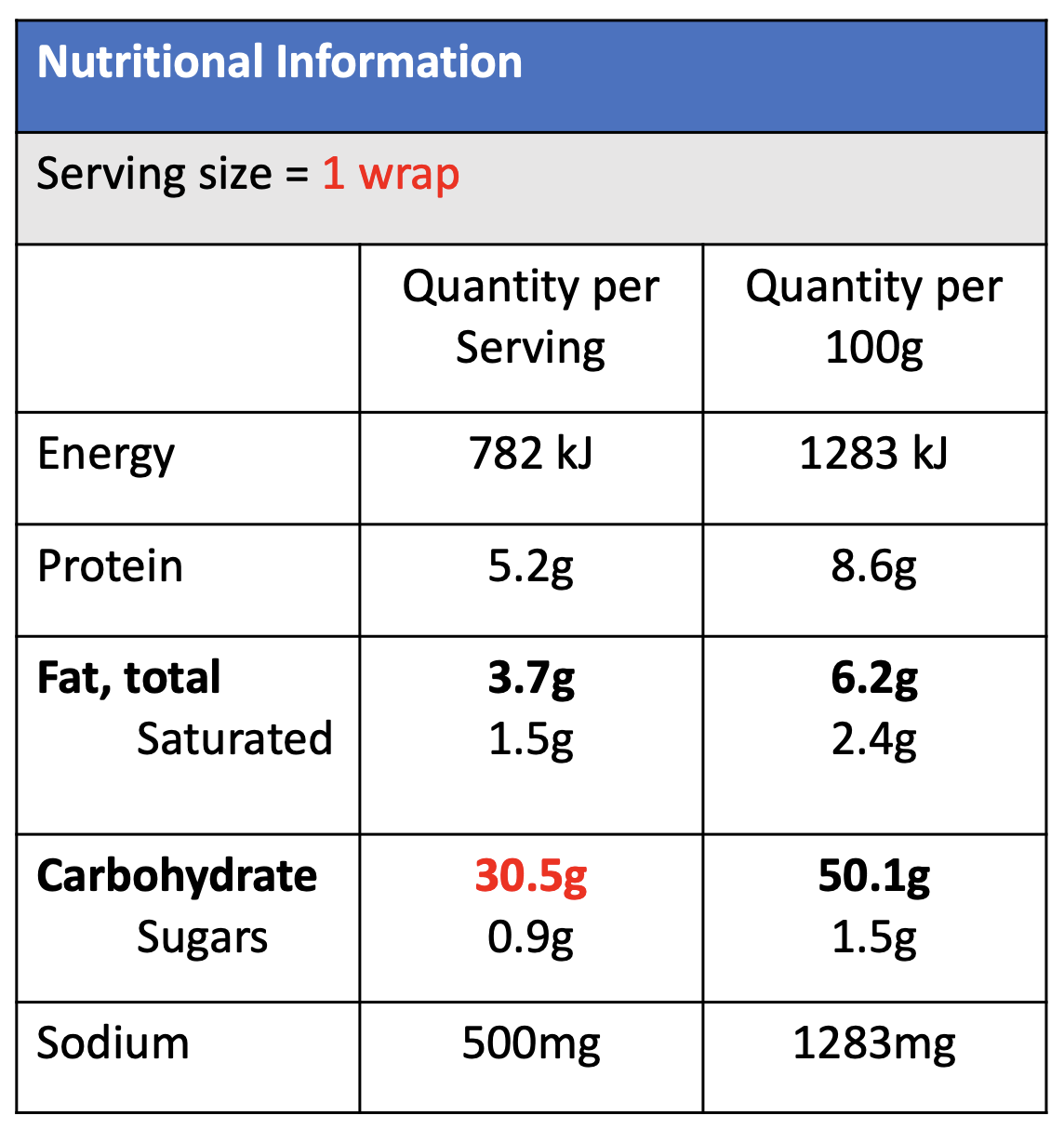
The first thing you need to do is check whether one wrap is equal to the manufacturer's classification of one serving size. In this case, one wrap is considered one serving (see the serving size text in red below).
Be wary that some manufacturers tend to make a conservative estimate of the average amount that you'll eat in one sitting, which can often be unrealistic. For example, a small tub of yoghurt may be classed as '2 servings' by the manufacturer, when in fact, you'd usually eat the whole tub at once.
Step 2
Check the amount of carbohydrates per serving (i.e. per single wrap). In this example, there's 30.5g of carbohydrate in one wrap. Remember that on the Second Nature programme, one serving of carbohydrate is equal to 15g, so this wholegrain wrap would count towards two of your daily carbohydrate servings.
Example 2 - Wholegrain cracker biscuit
Step 1
As per our example above, the first step involves identifying your serving size and seeing whether this aligns with the manufacturer's version of one serving.
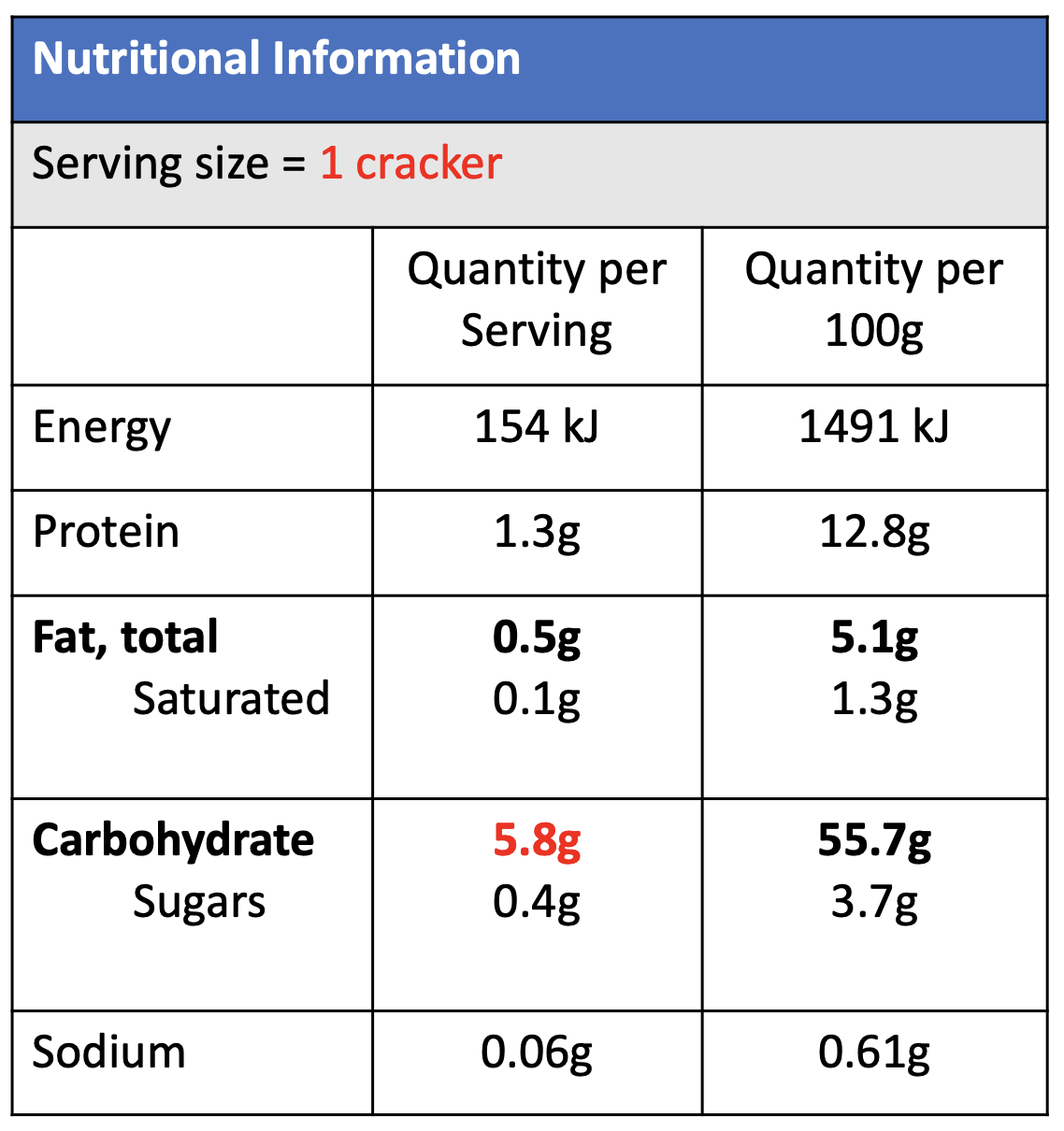
In this case, one serving size is equal to one cracker. However, in reality, it's more likely that we'd eat a few crackers in one sitting. For the example below, let's assume you'll eat three crackers in one sitting.
Step 2
If you're having three crackers and the manufacturer's version of a serving size is one cracker, then you can simply multiply the amount of carbohydrates in one serving by three.
In the example above, this would give you approximately 17.4g (5.8g x 3) of carbohydrates, which is the equivalent to just over one of your recommended carbohydrate servings per day.
Example 3 - Tinned chickpeas
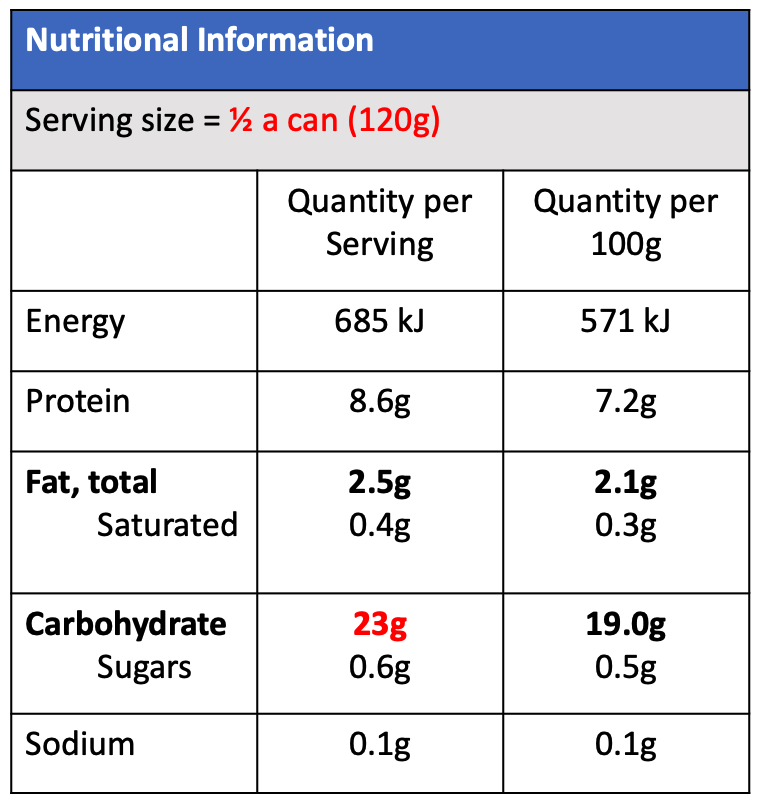
Other products, such as tinned chickpeas, might only display their serving size in grams. In the example below, the manufacturer has determined that one serving size is equal to 120g or half a can (this is drained chickpeas, with the water removed).
There’s a simple way you can determine the amount of carbohydrates in your serving size in this example.
Firstly, you can use kitchen scales to measure how much you'll be eating in one sitting. For example, you might measure 80g of chickpeas.
To determine the amount of carbohydrate in 80g, we can work out the amount of carbs in one gram and multiply this by 80. To do this, take the total number of carbs in 100g (in this case, 19.0g) and divide this by 100. This will give you 0.19, which means there is 0.19g of carbohydrate in every one gram of your chosen food. You can then multiply this number by 80g to get the total amount of carbs in 80g, which is equal to 15.2g of carbs.
Here's this equation written out:
Step 1: 19g/100g = 0.19g of carbs per 1g of chickpeas
Step 2: 0.19g x 80g = 15.2g carbs in 80g of chickpeas
Step 3: 15.2g is equal to 1 complex carbohydrate serving.
You can apply this equation to any food that you can weigh.
How to calculate carb servings in recipes
If you'd like to work out how many carbs are in a recipe that you're making, you can use the following method. Start by checking how much you need to use of this particular ingredient in the recipe. If the recipe calls for one can of chickpeas, then you can multiply the manufacturer's serving size (half a can) by two to get the total amount of carbs in the recipe. In this case, that would be 32.6g (which is 16.3g x 2).
The second step is to divide this total amount of carbs in the recipe by the serving size of your recipe. For example, if the recipe serves four people, divide the total number of carbs by four. In this case, if our recipe contains a total of 32.6g of carbohydrate and it serves four people, each person will be getting 8.1g of carbs, which is the equivalent to approximately 0.5 carbohydrate servings.
If you'd like further guidance on how to calculate your carb servings, you can watch this video with one of our health coaches Marianne:
Alternative ways to measure your carb servings
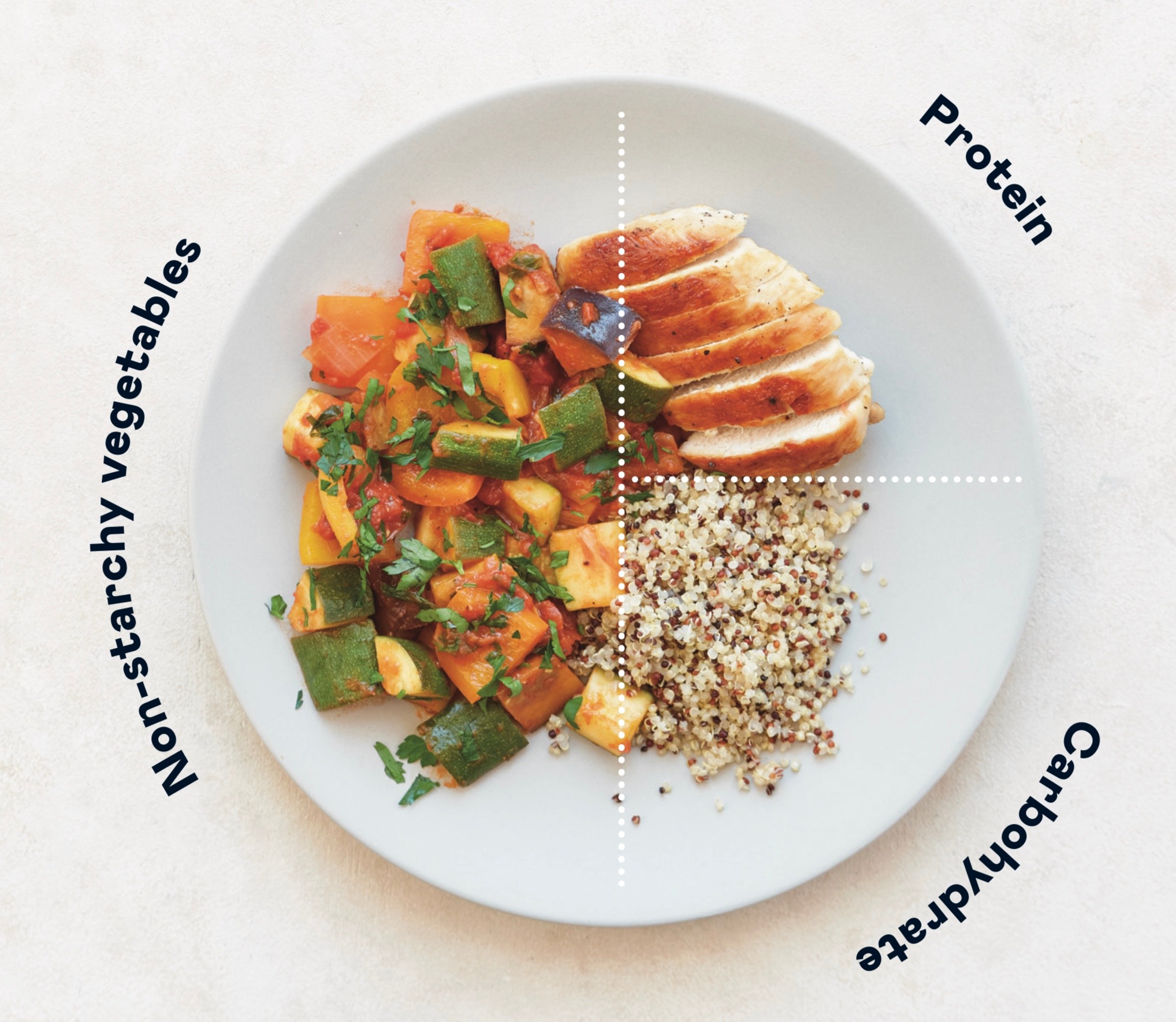
Whilst calculating carbohydrate servings at the beginning may seem complicated, it does get much easier over time. If you're less concerned with exact numbers, remember that the 'Balanced plate model' is another alternative way to measure your carb servings. We recommend filling no more than a quarter of your plate with complex carbohydrates.
Another alternative is to use visual serving sizes as follows:
Aim for one closed fist size of carbohydrate on your plate (making up 25% of your meal) ✊🏽
Two open, cupped hands for your vegetable intake (making up 50% of your meal) 👐🏽
A protein portion the size of the palm of your hand, excluding fingers, unless your protein source is fish (making up the final 25% of your meal) ✋🏽
A serving of healthy fats the size of your thumb 👍🏽